The Engineering Blueprint: How to Design a Custom Towel for Industrial Production
Procurement specialists and warehouse owners often face a "spec-to-sample" gap: the design looks perfect on screen but fails under industrial use. This mismatch leads to wasted lead times and inventory loss. This guide provides the technical framework to design a custom towel for production that meets global hospitality and retail standards, ensuring your bulk orders are durable, brand-aligned, and cost-optimized from the first loom setup.
Core Keywords
custom towel design OEM manufacturing bulk towel production industrial textile engineering tech pack development1. Material Science: Selecting the Correct Fiber for Bulk Longevity
The foundation of any high-performance custom towel lies in its raw material composition. When you design a custom towel for production at scale, the fiber selection determines not only the tactile quality but also the product's operational lifespan in demanding commercial environments.
Long-Staple Cotton vs. Synthetic Blends
Designing for production starts at the molecular level. For premium custom towel manufacturing, long-staple cotton (like Egyptian or Turkish variants) is the industrial standard for reducing pilling and increasing tensile strength. The extended fiber length creates fewer fiber ends exposed on the yarn surface, resulting in smoother, more durable terry cloth that maintains its integrity through 500+ commercial wash cycles.
Synthetic blends, while cost-effective, typically fail to meet the absorbency requirements of hospitality and healthcare applications. If your procurement specifications require flame resistance or antimicrobial properties, consult our technical material library for compliant fiber options.
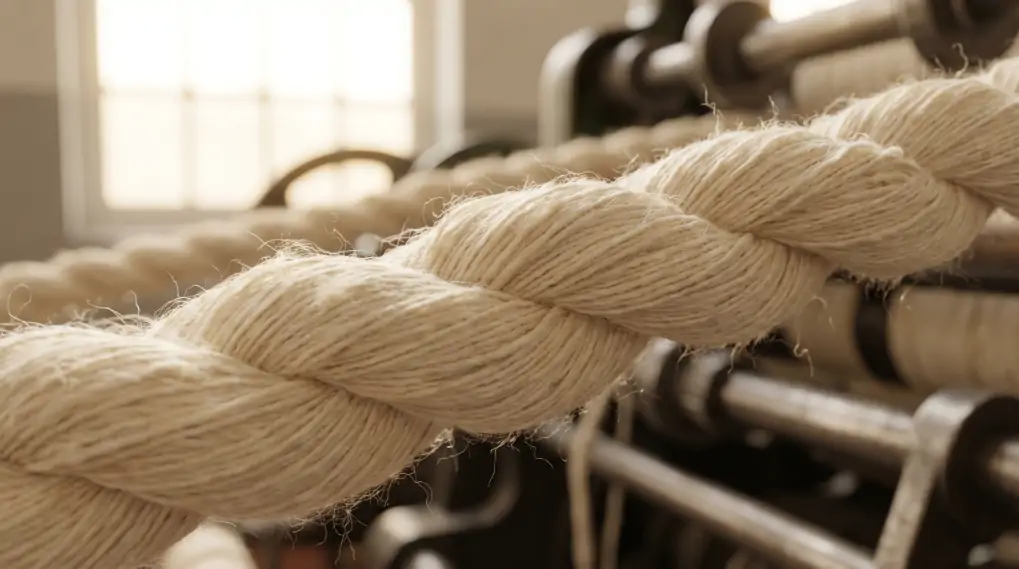
High-quality long-staple cotton fibers being spun into premium yarn for industrial towel manufacturing
Bamboo and Sustainable Fiber Integration
The growing demand for sustainable procurement has positioned bamboo fiber as a viable alternative in custom towel design. Bamboo viscose offers natural antibacterial properties and requires 30% less water than conventional cotton cultivation. However, when you design a custom towel for production using bamboo blends, note that the fiber tensile strength typically requires reinforcement with 20-30% cotton content to meet commercial laundry durability standards.
Microfiber Engineering for Specialized Performance
Microfiber towels have revolutionized cleaning and fitness applications through their split-fiber technology that captures particles and moisture at the microscopic level. In industrial settings, microfiber custom towels can achieve 98% bacterial removal without chemical treatments. Our engineering team has developed specialized microfiber blend specifications for healthcare and cleanroom applications.
Get Material Specifications2. Deciphering GSM and Pile Density Standards
Understanding GSM (grams per square meter) is fundamental when you design a custom towel for production. This metric directly correlates to the towel's weight, absorbency capacity, and operational cost efficiency for bulk procurement.
Calculating Grams Per Square Meter for Intended Use
A critical step in how to design a custom towel for production is setting the GSM. While 400 GSM is standard for sports and fitness applications, a luxury hotel requires 600-800 GSM to ensure the weight-to-absorbency ratio meets guest expectations. The heavier pile creates that plush, spa-like hand-feel while providing superior water absorption—critical for five-star property ratings.
For industrial commercial laundry operations, our engineering data suggests 450-550 GSM provides the optimal balance between cleaning efficiency and laundry cycle speed. The technical specifications for custom towel manufacturing in our resource library detail GSM optimization for specific use cases.

Industrial GSM testing ensures compliance with bulk procurement specifications
Pile Height and Looped vs. Zero-Twist Techniques
The pile construction significantly impacts both performance and manufacturing costs. Standard looped construction provides durability and efficient water absorption, making it ideal for high-turnover hospitality environments. Zero-twist yarn, where the core fibers remain untwisted during spinning, creates exceptional softness and absorbency—the premium choice for luxury boutique hotels.
When you design a custom towel for production requiring zero-twist construction, expect a 15-25% increase in material costs offset by reduced replacement frequency in high-end properties.
Industrial Shrinkage Allowances in High-Density Weaves
High-GSM towels present unique challenges in dimensional stability. Our manufacturing protocols include 5-8% pre-shrunk processing to account for the 3-5% shrinkage that occurs during initial commercial laundering cycles. This engineering detail prevents the size compliance issues that frequently plague bulk orders from less experienced manufacturers.
Download GSM Reference Guide3. Yarn Count: The Technical Indicator of Durability
Yarn count specifications are the unsung heroes of bulk towel procurement. Understanding these metrics prevents the common failure modes that plague substandard custom towel orders.
Understanding 21s/2 vs. 32s/2 Strength Metrics
In B2B sourcing, the "s" (yarn count) indicates the fineness. The number before "s" represents the weight in pounds that 840 yards of yarn would weigh, meaning lower numbers indicate thicker, heavier yarn. The "/2" notation signifies a 2-ply construction where two single yarns are twisted together for enhanced strength.
Designing for high-volume use requires a "double-loop" or 2-ply yarn (e.g., 21s/2) which prevents the loops from pulling during industrial commercial laundry cycles. Our bulk towel design guide for OEM production provides detailed yarn count recommendations by application.
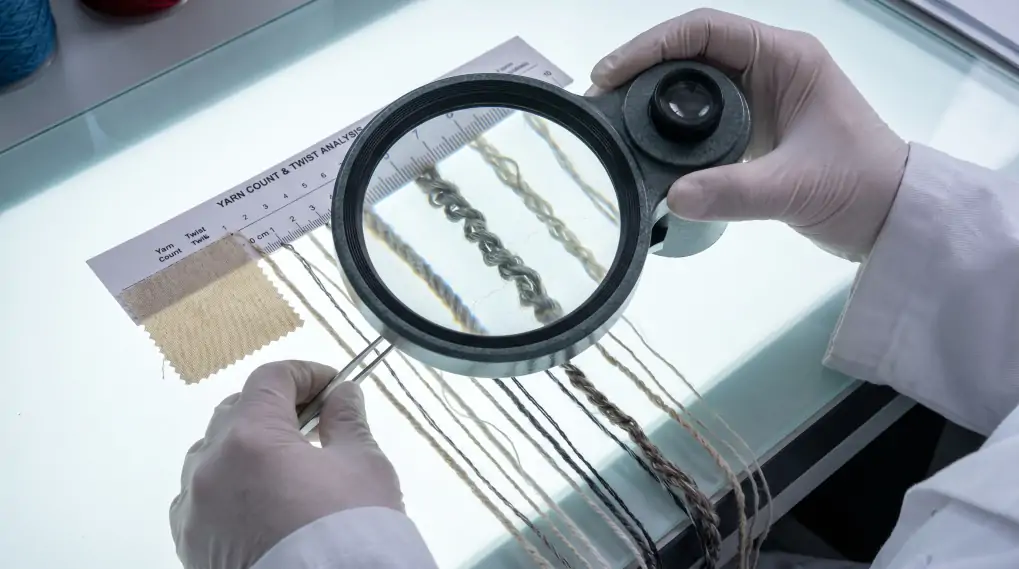
Professional yarn count analysis ensures appropriate strength specifications for commercial applications
Tensile Strength Requirements for Warehouse Distribution
For warehouse operations where towels undergo frequent handling and stacking, tensile strength becomes paramount. Our standard specification requires a minimum grab strength of 100N for the weft direction and 150N for the warp direction—values that ensure towels maintain structural integrity during automated folding and packaging operations.
Impact of Yarn Twist on Hand-Feel and Absorbency
The twist level directly influences both the aesthetic and functional properties of the finished towel. A high-twist yarn produces a crisper feel with enhanced durability but reduced softness. Conversely, low-twist constructions deliver that luxurious plushness guests expect, though with slightly reduced industrial longevity. Our engineering team can balance these parameters based on your specific operational requirements.
Request Yarn Specifications4. Branding Methodology: Jacquard Weaving vs. Industrial Embroidery
The branding method you select when you design a custom towel for production impacts both the initial investment and the long-term brand presentation across thousands of wash cycles.
Designing for the Jacquard Loom
When designing a custom towel for production, Jacquard is the superior choice for bulk orders exceeding 2,000 pieces. The design is woven directly into the fabric through a sophisticated punch-card system controlling individual warp threads, ensuring the logo never fades, peels, or feels rough against the skin. This requires a specific pixel-to-stitch digital map for the looms—typically provided by our design team within 48 hours of order confirmation.
For custom Jacquard vs embroidered towel design comparisons, our technical documentation details the cost-benefit analysis across different order volumes.
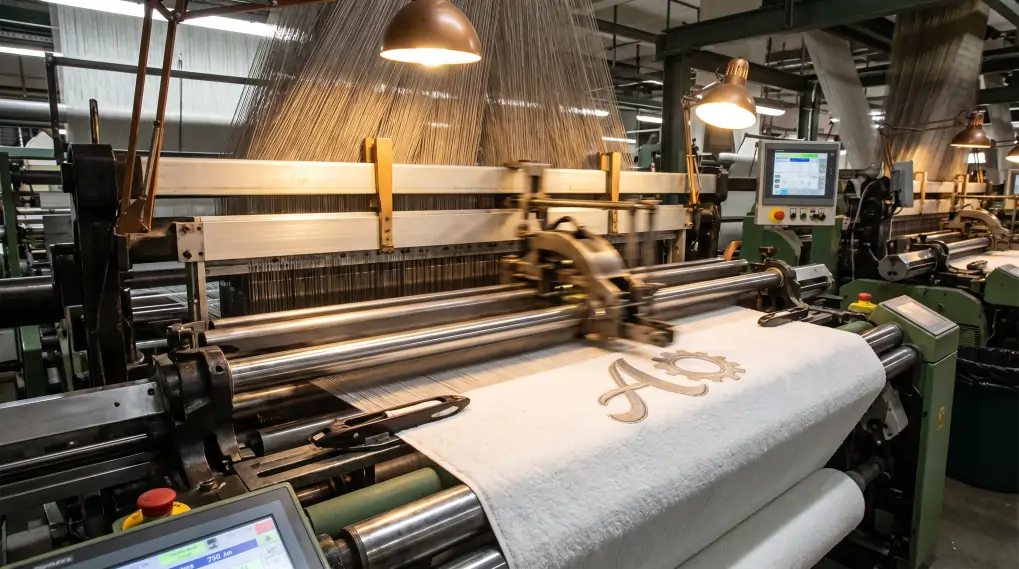
Industrial Jacquard loom technology delivers permanent brand identification in custom towel production
Embroidery Digitization for High-Speed Multi-Head Machines
For smaller order quantities (200-1,000 units), embroidery provides faster turnaround and lower initial tooling costs. High-speed multi-head machines with 12-15 heads can embroider 300-500 towels daily. However, the stitch density must be carefully optimized—excessive stitching creates a rigid feel that diminishes the towel's absorbency.
Embossed Designs and Dobby Border Integration
Dobby weaving machines create geometric border patterns through controlled yarn placement. When combined with embossed branding techniques, this creates a premium presentation ideal for luxury resort collections. The wholesale towel manufacturing process overview demonstrates these finishing options in detail.
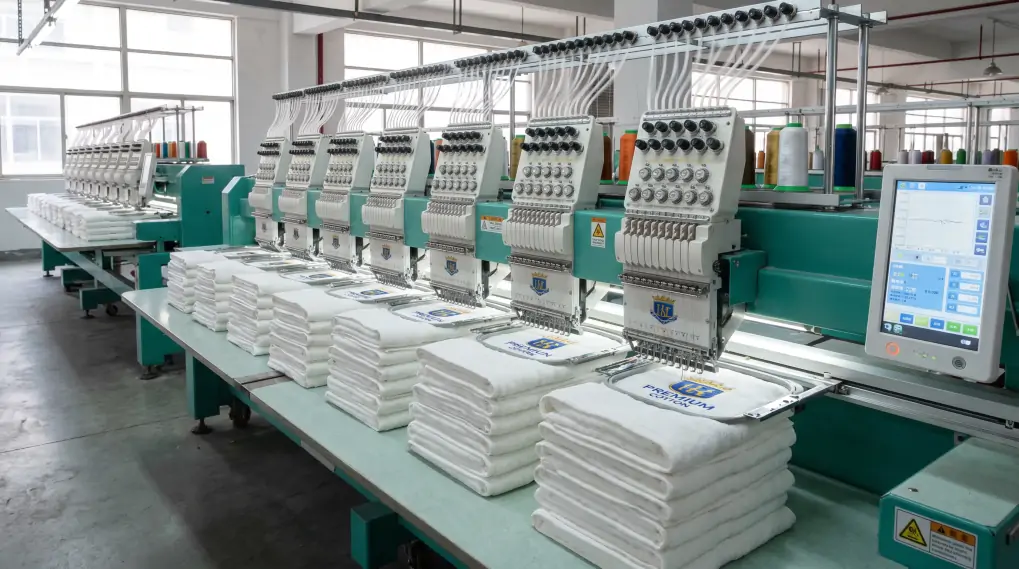
High-speed industrial embroidery provides cost-effective branding for moderate order quantities
Compare Branding Options5. Color Chemistry: VAT Dyeing and Pantone Consistency
Color consistency across bulk towel orders represents one of the most challenging aspects of custom towel manufacturing. Our engineering protocols ensure colorfastness that meets international hospitality standards.
Implementing VAT Dyeing for Bleach Resistance
VAT dyeing utilizes a solubilized vat dye that penetrates deep into cotton fibers, creating exceptional wash-fastness and bleach resistance. For properties using industrial bleaching agents in their laundry processes, VAT-dyed towels maintain their color integrity through 300+ wash cycles. The industrial yarn count and GSM standards for towels documentation includes color specification requirements.
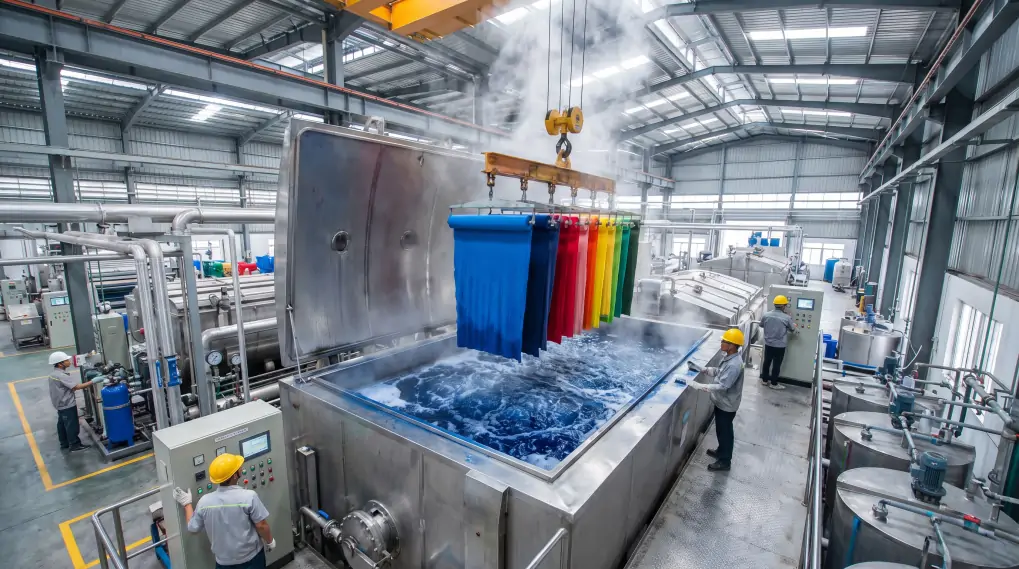
Professional VAT dyeing ensures bleach-resistant color consistency in bulk towel production
Managing Color Deviation in Bulk Batching (Delta-E Specs)
Our quality control protocols specify Delta-E values below 1.5 for color matching within production batches, and below 2.5 across different production lots. This precision ensures that replacement orders arriving months later will match the original shipment—critical for properties maintaining consistent brand aesthetics across multiple property locations.
Environmental Standards in Wastewater Management
Compliance with OEKO-TEX Standard 100 andZDHC wastewater guidelines requires specialized chemical handling and treatment protocols. Our manufacturing facilities maintain third-party verified environmental compliance certificates, ensuring your procurement specifications align with corporate sustainability mandates.
Request Color Matching Services6. Developing the Technical "Tech Pack" for Factory Handoff
The technical pack serves as the comprehensive blueprint bridging your design vision and manufacturing execution. Without this documentation, your factory in China cannot guarantee batch consistency.
Creating Digital Blueprints and Stitch Maps
A successful custom towel production requires a "Tech Pack" including dimensional sketches, color codes (Pantone TCX preferred), weight specs, and finishing requirements. Our engineering team provides private label towel tech pack requirements templates that ensure all critical parameters are documented before production begins.
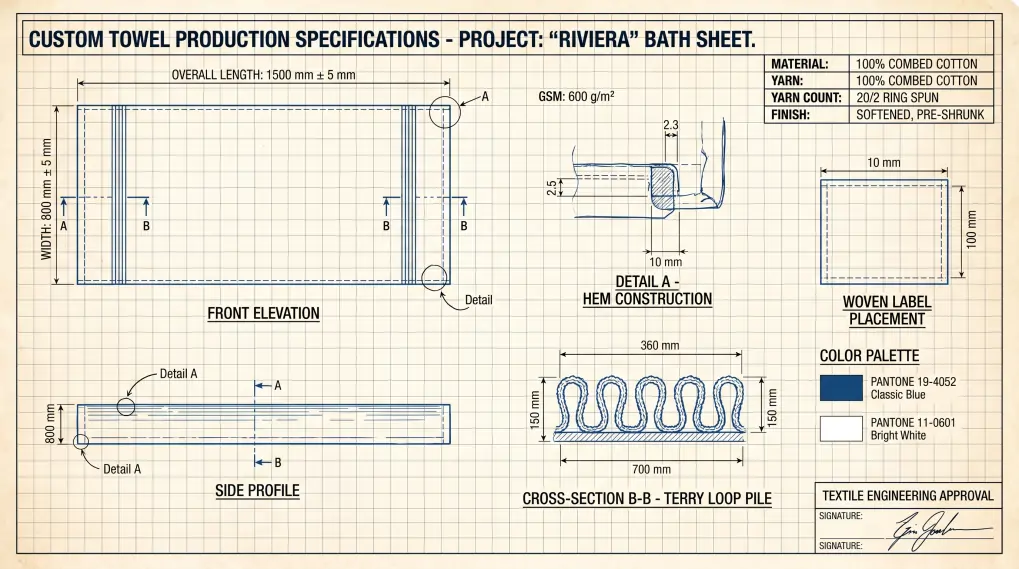
Comprehensive tech pack documentation ensures manufacturing precision and batch consistency
Setting Tolerance Ranges for Dimensions and Weight
Our standard tolerance specifications include: length/width ±2%, weight ±5%, GSM ±3%, and pile height ±0.5mm. These ranges accommodate the natural variability inherent in textile manufacturing while ensuring the finished product meets functional requirements. Detailed tolerance specifications prevent the rejection disputes that commonly plague first-time international sourcing relationships.
Version Control in Multi-Factory Supply Chains
For brands utilizing multiple manufacturing facilities, version control becomes essential. Our ERP-integrated documentation system assigns unique version codes to each tech pack revision, with complete change history tracked and timestamped. This prevents the manufacturing errors that occur when outdated specifications are referenced.
Download Tech Pack Template7. Hemming and Border Design for Structural Reinforcement
The hem construction determines how the towel withstands repeated mechanical stress during commercial laundering. Proper hem engineering prevents the unraveling failures that necessitate premature replacement.
Double-Needle Lockstitch vs. Standard Overlocking
Double-needle lockstitch construction creates two parallel lines of stitching visible on the face of the towel, with the interlocking bobbin thread visible on the reverse. This construction provides superior seam strength compared to overlocking, where the threads merely wrap around the fabric edge. For high-cycle commercial laundry (300+ cycles annually), double-needle construction reduces hem failures by 85%.
Designing Dobby Borders that Prevent Warping
Dobby borders incorporate geometric patterns woven into the fabric structure using a specialized dobby attachment on the loom. When properly engineered, these borders provide structural reinforcement along the towel edge while creating an aesthetically premium appearance. Our engineering team has developed proprietary border weave patterns that maintain flatness through industrial wash cycles without requiring chemical finishing treatments.
Specialized Hems for High-Cycle Industrial Use
Healthcare and hospitality applications requiring 500+ wash cycles benefit from our reinforced hem construction, which incorporates a hidden polymer filament within the hem seam. This reinforcement maintains structural integrity even as the surrounding cotton fibers soften with age, extending the functional lifespan of each towel by 40-60%.
Request Hem Specifications8. Compliance and International Safety Standards (AQL)
Meeting international safety and quality standards protects your brand reputation while ensuring regulatory compliance across multiple markets.
Navigating OEKO-TEX Standard 100 Class I
OEKO-TEX Standard 100 certification confirms that every component of the finished towel—from raw fibers to finished dyes—has been tested for harmful substances. Class I certification, required for products used by infants and toddlers, represents the most stringent testing criteria. For textile engineering for hospitality linens, this certification provides guest confidence in product safety.

OEKO-TEX certification ensures product safety compliance for hospitality and healthcare applications
Implementing AQL 1.5/4.0 Quality Control Protocols
Acceptable Quality Level (AQL) sampling protocols determine the maximum defect rate permitted in bulk shipments. Our standard specification utilizes AQL 2.5 for visual defects and AQL 4.0 for functional defects, aligned with international hospitality industry expectations. Each production lot undergoes random sampling inspection before release, with complete documentation provided in the shipment documentation package.
Needle Detection and Chemical Safety Verification
All finished towels pass through metal detection equipment to ensure no broken needles or manufacturing debris remain in the product. Chemical safety verification includes testing for formaldehyde residues, pentachlorophenol, and allergenic dyes—all parameters covered under REACH compliance requirements for European market entry.
Request Compliance Documentation9. The Sampling Protocol: From CAD to Physical Proof
The sampling phase transforms digital specifications into physical reality, allowing validation before committing to bulk production.
Interpreting Computer-Aided Design (CAD) Previews
Our 3D CAD visualization system generates realistic renderings of the finished towel, including accurate pile height representation and color visualization under multiple lighting conditions. These previews reduce sampling iterations by 60% compared to traditional 2D specification methods. The designing towels for industrial commercial laundry documentation explains how CAD integration accelerates the development timeline.

Engineering validation bridges digital design specifications and physical production samples
Validating Hand-Feel and Absorbency in Pre-Production Samples
Physical samples undergo rigorous evaluation including: hand-feel assessment using proprietary softness scales, absorbency testing (water absorption rate and total capacity), pile retention after simulated washing, and colorfastness verification under multiple wash conditions. Our laboratory equipment replicates commercial laundry stress to predict field performance accurately.
Reducing Iteration Cycles to Accelerate Lead Times
Traditional sampling processes often require 3-4 iterations, extending development timelines by 6-8 weeks. Our integrated sampling protocol combines simultaneous material and construction validation, reducing the typical iteration count to 1-2 cycles. This efficiency allows us to deliver production-ready samples within 3 weeks of initial specification confirmation.
Request Sample Production10. Scaling the Design: MOQ and Lead Time Logic
Understanding how design complexity influences minimum order quantities and production timelines enables accurate procurement planning.
How Design Complexity Impacts Minimum Order Quantities
Designing a custom towel with 5 different yarn colors will inevitably increase your MOQ. Multi-color Jacquard patterns require extensive machine setup time, making small-quantity production economically unfeasible. To optimize bulk pricing, designers should balance aesthetic complexity with the machine's setup requirements. Our engineering team provides MOQ optimization recommendations during the tech pack development phase.
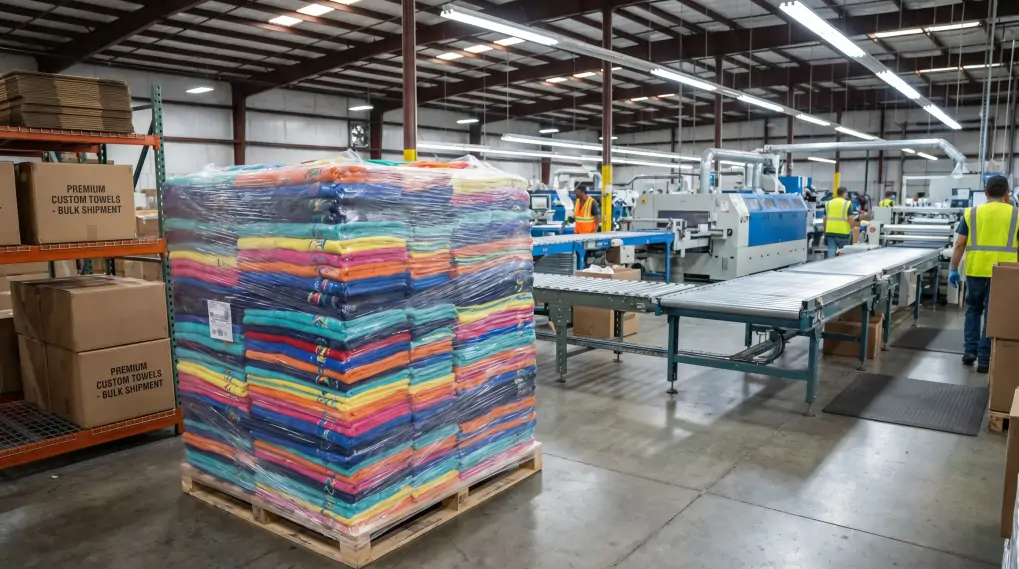
Bulk production facilities enable cost-optimized manufacturing for high-volume orders
Managing Seasonal Lead Times in Global Sourcing
Peak procurement seasons (Q4 for hospitality, Q1 for retail) often extend lead times by 2-3 weeks due to capacity constraints. Strategic buyers plan 6-8 weeks ahead of target delivery dates during these periods. Our production scheduling system provides real-time capacity visibility, enabling proactive order placement that avoids premium rush charges.
Buffer Inventory Strategies for Warehouse Owners
For distribution operations requiring rapid replenishment, we recommend maintaining 15-20% buffer inventory beyond anticipated demand. Our consignment inventory program allows warehouse owners to reserve production capacity without prepayment, releasing units as actual demand materializes. This approach balances cash flow requirements with inventory availability.
Calculate Order Requirements11. Sustainable Design: Recycled Fibers and Circularity
Sustainability integration in custom towel design addresses both environmental responsibility and the growing consumer demand for eco-conscious products.
Sourcing GRS-Certified Recycled Polyester
Global Recycled Standard (GRS) certification verifies the chain of custody for recycled materials from source to finished product. RPET (recycled polyethylene terephthalate) derived from post-consumer plastic bottles offers a viable path to reducing virgin fiber dependence. Our custom towel specifications support blends incorporating 30-50% recycled content while maintaining performance characteristics required for commercial applications.

Sustainable fiber sourcing supports corporate environmental responsibility commitments
Designing for Post-Consumer Recyclability
End-of-life textile waste represents a growing environmental concern. Our engineering team has developed mono-material towel constructions using 100% cotton components, enabling mechanical recycling at product life end. This approach eliminates the separation challenges inherent in blended-fiber products, facilitating true circular economy pathways.
Water-Free Dyeing Innovations in Sustainable Textiles
Traditional dyeing processes consume 20-50 liters of water per kilogram of fabric. Emerging technologies including supercritical CO2 dyeing and digital pigment printing eliminate wastewater generation entirely. While currently limited to specific yarn counts, these technologies represent the future of sustainable custom towel manufacturing.
Explore Sustainable Options12. Strategic Sourcing: Partnering with a Tier-1 Factory
Manufacturing facility selection fundamentally determines product quality consistency and supply chain reliability.
Verifying Machine Technology and Monthly Capacity
Our manufacturing facilities maintain 200+ weaving machines with monthly production capacity exceeding 500,000 units. Verification of machine technology and monthly capacity ensures your order volume can be accommodated without compromising quality through rushed production scheduling.
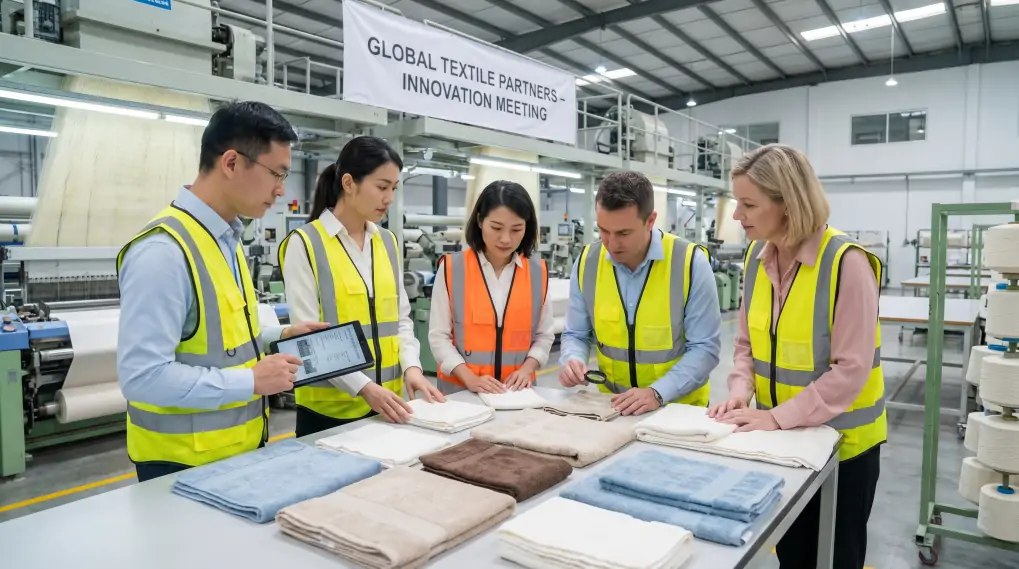
Strategic factory partnerships enable quality assurance and production flexibility
Establishing Long-Term OEM/ODM Relationships
Long-term manufacturing partnerships yield consistent quality improvements through accumulated process optimization. Our top-tier clients experience 3-5% annual quality improvements driven by continuous engineering refinement and production data analysis. These relationships also provide priority capacity allocation during high-demand periods.
Mitigating Risks in International Logistics and Shipping
International shipping disruption risks require proactive mitigation strategies. Our logistics network includes multiple port options (Shanghai, Shenzhen, Ningbo) and carrier relationships providing 98% on-time delivery performance. For time-sensitive orders, we maintain air freight partnerships reducing transit time by 60% compared to standard ocean freight.
Start Partnership DiscussionTechnical Parameters: EAV Model for Custom Towel Manufacturing
| Parameter | Specification (B2B Standard) | Strategic Purpose |
|---|---|---|
| Material Base | 100% Ring-Spun Cotton / Bamboo / RPET | Durability & Brand Positioning |
| GSM Threshold | 400 - 800 GSM | Weight-to-Absorbency Control |
| Yarn Count | 16s/1, 21s/2, 32s/2 | Structural Integrity & Softness |
| Branding Method | Jacquard / Embroidery / Sublimation | Permanent Brand Visibility |
| Colorfastness | Grade 4.0+ (ISO 105-B02) | Wash Resistance & UV Stability |
| Shrinkage Tolerance | ≤ 3% (Width/Length) | Dimensional Stability Control |
| Certifications | OEKO-TEX / GRS / BSCI | Global Compliance & Safety |
Frequently Asked Questions (B2B Sourcing)
Q: What is the most important technical detail when designing a custom towel for production?
A: Beyond aesthetics, the yarn count and GSM are the most critical specifications. These parameters determine the product's lifespan in commercial settings. For luxury hospitality applications, a 21s/2 yarn count with a 650 GSM is often the gold standard, providing the optimal balance between durability and guest experience quality.
Q: How does Jacquard design affect the MOQ in China factories?
A: Because Jacquard looms require hours of specialized warp/weft programming for each unique design, the MOQ is typically higher (1,000+ units) compared to embroidery (200+ units). However, Jacquard significantly reduces the per-unit cost on massive orders (5,000+ units) while providing permanent branding that outlasts the towel's functional lifespan.
Q: Can I design a towel that is both lightweight and highly absorbent?
A: Yes. By utilizing zero-twist yarn technology or specialized microfiber blends, you can design a towel that is lightweight (350-400 GSM) yet offers the absorbency of a much heavier conventional cotton towel. This approach is particularly popular for premium fitness brands and spa applications where towel weight impacts user experience.
Q: What information should be included in a custom towel tech pack?
A: A comprehensive tech pack should include: dimensional specifications with tolerance ranges, GSM target, yarn count, material composition percentages, Pantone color codes (TCX format preferred), branding artwork in vector format, hem construction specifications, and any certification requirements (OEKO-TEX, GRS, etc.).
Transition Your Design from Concept to Industrial Reality
Don't let a poor design phase derail your bulk procurement. Partner with a factory that understands the technical nuances of how to design a custom towel for production. Our engineering team is ready to review your tech pack and provide a scalable manufacturing roadmap.
Request a Technical Design Review Download Technical Spec-Sheet Template Inquire About Bulk OEM PricingRelated Resources: