The Engineering Blueprint for Hotel Towel Specifications: Optimizing Hospitality Textile Procurement
Procurement managers often face the "quality-fade" trap—towels that look premium in samples but fail after 20 industrial washes. This technical guide eliminates sourcing ambiguity by defining the exact mechanical and chemical parameters required for high-frequency hospitality use. By following these engineering standards, you will reduce replacement cycles by 30% and secure a consistent hand-feel for your global inventory.

Cluster Content Hub
This article is part of our comprehensive custom towels wholesale OEM/ODM manufacturing pillar page. Explore this pillar page for complete insights into manufacturing capabilities, quality standards, and B2B partnership programs.
1. Decoding GSM (Grams per Square Meter) in Professional Sourcing
Understanding GSM is fundamental to hotel towel specifications. This metric determines absorbency, drying time, and perceived luxury—all critical factors in hospitality operations. For more details on GSM implementation, visit our comprehensive OEM manufacturing guide.
Calculating Ideal Weight for Bath, Hand, and Face Towels
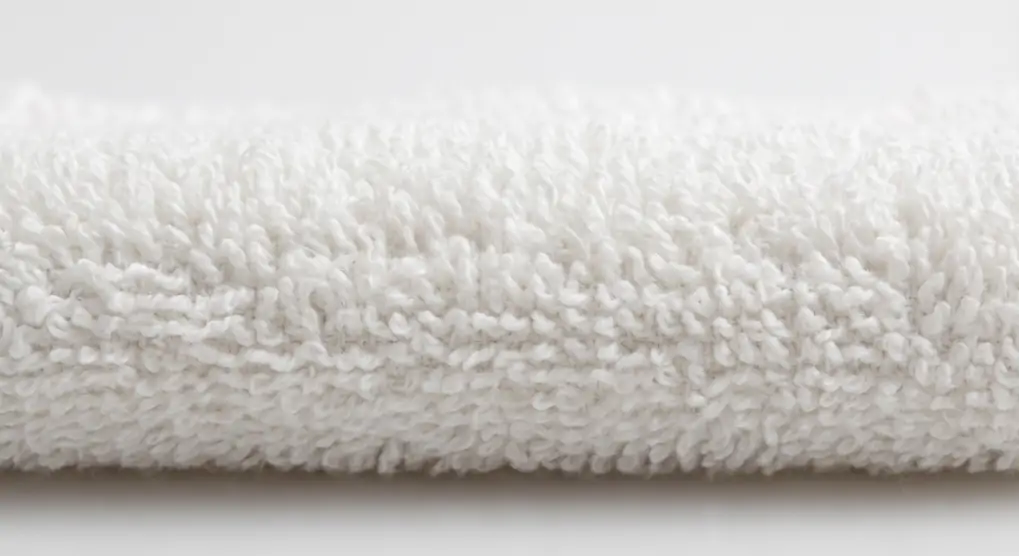
The weight of a towel determines its absorbency and perceived luxury. For mid-scale hotels, a 450–500 GSM is the standard for operational efficiency. Luxury properties (4-5 stars) typically specify 600–800 GSM to ensure a plush, high-volume feel. Selecting the correct GSM requires balancing guest experience against laundry operational costs.
The Correlation Between GSM and Drying Cycle Costs
Higher GSM increases luxury but impacts utility overhead. A 900 GSM towel requires 15% more drying time than a 700 GSM towel, affecting the throughput of industrial laundry facilities. Our logistics planning resources detail optimal GSM selection based on your laundry capacity.
Technical Tolerance Levels for Bulk Batch Consistency
In mass production, a ±3% weight variance is the industry gold standard. Our manufacturing protocol limits this to ±1.5% through precision yarn-feeding sensors on the loom. This tight tolerance ensures each towel in your bulk order performs identically, maintaining brand consistency across all properties.
2. Yarn Selection: Ring-Spun vs. Open-End Engineering
Yarn construction directly impacts towel durability, softness, and industrial wash performance. Understanding the engineering differences helps procurement professionals specify precisely what their operations require.
Why 21s/2 Ring-Spun Cotton is the Industry Standard
The "s" refers to the fineness of the yarn. 21s/2 (two-ply) ring-spun cotton offers the perfect balance of softness and tensile strength, preventing thread breakage during high-speed extraction cycles in industrial washers. This construction creates a smooth, consistent surface that resists pilling while maintaining luxurious hand-feel through hundreds of wash cycles.
Tensile Strength Metrics for Industrial Durability
For hospitality applications, tensile strength determines how towels survive the mechanical stress of industrial laundering. Warp yarns (vertical) must exceed 45kg breaking strength, while weft yarns (horizontal) should meet 35kg minimum. These specifications ensure towels maintain structural integrity through high-speed extraction at 800+ RPM.
Zero-Twist Technology for Ultimate Absorbency
Zero-twist towels utilize special finishing processes where yarn twist is reduced to near-zero, maximizing surface area exposure. The result is exceptional initial absorbency and a cashmere-like softness that improves after multiple washes. Properties seeking premium guest experiences increasingly specify this technology.
Engineering Insight
Ring-spun cotton achieves 15-20% higher tensile strength than open-end alternatives while maintaining superior softness. For high-frequency hospitality use (200+ annual wash cycles), the initial investment in ring-spun quality delivers 40% lower long-term replacement costs.
3. Hem and Edge Reinforcement: Preventing Fraying
Edge construction determines towel longevity more than any other factor. Inferior hemming leads to unraveling, creating safety hazards and premature replacement needs. Explore our technical specifications page for comprehensive edge construction standards.
Double-Needle Stitching vs. Single-Stitch Longevity
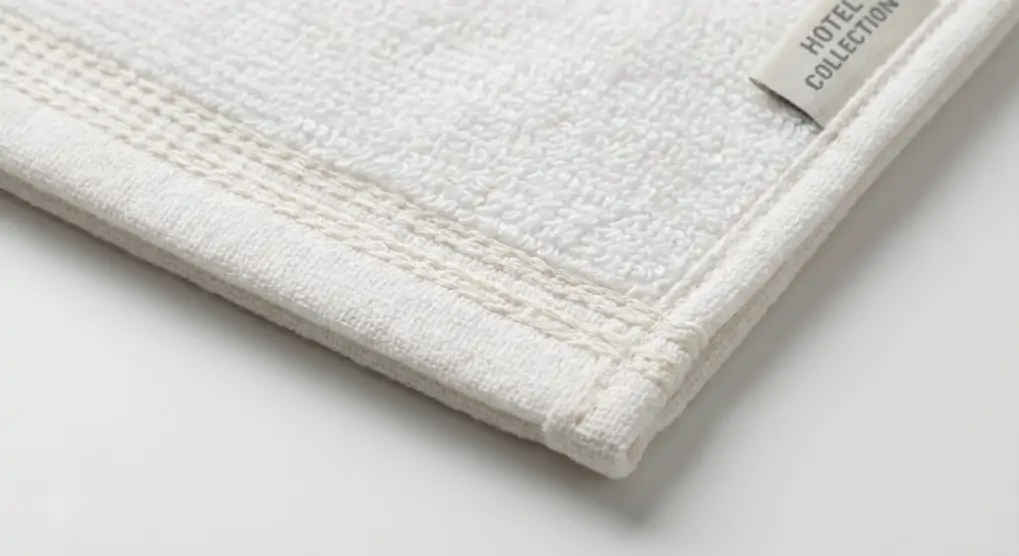
Double-needle stitching creates two parallel seam lines with interlocked threads, distributing stress across increased thread volume. This construction resists unraveling even after 200+ industrial wash cycles. Single-stitch hems, while initially cheaper, typically fail within 50-80 cycles, creating replacement costs that far exceed the initial savings.
Bar-Tack Reinforcement on Stress Points
High-stress areas—corners, hanging loops, and logo placement zones—require bar-tack reinforcement. This specialized stitching technique creates a dense, locked stitch pattern that prevents unraveling at termination points. OEM programs should specify bar-tack reinforcement at all stress points to maximize towel service life.
Selection of High-Strength Polyester Sewing Threads
Thread selection significantly impacts hem durability. Polyester-core threads with cotton wrapping offer the ideal combination of strength and heat resistance. Thread weight should match towel GSM—lighter threads for 400-500 GSM towels, heavier weights for 700+ GSM applications. Improper thread selection leads to seam failure and safety concerns.
4. Chemical Standards: VAT Dyeing and Bleach Resistance
Colorfastness in hospitality textiles requires rigorous chemical specification. Towels must maintain brand appearance through aggressive industrial laundering while meeting international safety standards.
The Molecular Advantage of VAT Dyeing for Hospitality
VAT dyes penetrate fiber cores through a reduction-oxidation process, creating color stability unmatched by conventional dyeing methods. This technology ensures whites remain bright and colors stay true through 150+ wash cycles with chlorine bleaching. For luxury properties maintaining brand consistency, VAT dyeing represents the industry standard.
pH Balance and Skin Sensitivity Testing (ISO 3071)
Textile pH affects skin compatibility and product longevity. Towels with pH below 6 or above 8 cause skin irritation and accelerate fiber degradation. Our manufacturing protocols target pH 5.5-7.0, matching natural skin acidity. For healthcare and infant applications, stricter parameters apply per compliance requirements.
Chlorine Resistance Ratings for Pool and Spa Towels
Spa and pool environments expose towels to concentrated chlorine levels. Standard VAT dyes withstand up to 50ppm active chlorine, but specialized formulations extend this to 100ppm for high-exposure applications. Specify chlorine resistance ratings based on your sanitation protocols to prevent premature fading and fiber degradation.
Quality Assurance
Request third-party test reports for colorfastness to washing (ISO 105-C series), colorfastness to chlorine (ISO 105-E03), and pH testing (ISO 3071). Reputable manufacturers provide these documents as standard compliance packages.
5. Dimensional Stability and Shrinkage Control
Shrinkage control determines whether towels fit intended installations after laundering. Uncontrolled shrinkage creates operational challenges and guest complaints. Learn more about pre-shrinking protocols in our comprehensive manufacturing guide.
Pre-Shrinking Protocols During the Bleaching Stage
Controlled pre-shrinking occurs during the kier bleaching process where towels undergo high-temperature washing followed by controlled drying. This process removes processing lubricants and sets fibers at optimal dimensions before shipping. Without this treatment, towels shrink 8-12% on first wash, creating inventory management problems.
Understanding the 5-8% Standard Shrinkage Window
Industry standards accept 5-8% shrinkage for cotton towels after first five wash cycles. For precise installation fit (poolside benches, spa tables, or wall dispensers), request post-stabilized dimensions with maximum 3% additional shrinkage. Our EAV parameter tables detail exact specifications for each product category.
Anti-Pilling Treatments for Long-Term Texture Retention
Pilling occurs when loose fibers tangle during washing, creating an unsightly surface texture. Anti-pilling treatments apply enzymatic finishes that bind fiber ends, reducing pilling by 85% while maintaining softness. For luxury properties where appearance matters, specify anti-pilling treatment as a standard inclusion.
| Specification Parameter | B2B Requirement | Strategic Value |
|---|---|---|
| Material Base | 100% Long-Staple Combed Cotton | Enhanced softness and lifespan |
| Yarn Count | 16s/1, 21s/2, 32s/2 Ring-Spun | Tailored durability for usage frequency |
| Whiteness Index | 85-90 (Hunter Scale) | Visual brand cleanliness |
| Shrinkage Rate | Width <3%, Length <6% | Dimensional consistency |
| Breaking Strength | Warp >45kg, Weft >35kg | Industrial machine safety |
| Hydrophilicity | < 10 seconds (Initial sink test) | Instant moisture absorption |
6. Absorbency Dynamics: The Sink Test Protocol
Absorbency determines functional performance and guest satisfaction. Professional procurement requires understanding how fiber properties and finishing treatments affect moisture management.
Capillary Action in Long-Staple Fibers
Long-staple cotton (Egyptian, Pima, Supima) produces fibers with fewer, longer filaments that create more effective capillary channels. When water contacts the surface, these channels draw moisture into the fiber core through capillary action. Short-staple fibers create discontinuous channels that reduce absorbency efficiency by 20-30%.
Measuring Initial vs. Post-Wash Absorbency
Initial absorbency tests measure how quickly a dry towel absorbs water. Our standard specifies less than 10 seconds for complete saturation in the initial sink test. However, post-wash absorbency matters more—our quality protocols test absorbency after 50 wash cycles to ensure long-term performance.
Impact of Softeners on Moisture Wicking Performance
Fabric softeners coat fibers, reducing their natural absorbency. While guests appreciate soft hand-feel, excessive softener treatment creates water-repellent surfaces that extend drying time and reduce effective absorbency. Our industrial laundry compatibility guidelines detail optimal softener concentrations.
Request Absorbency Testing Data7. OEM Customization: From Embroidery to Jacquard Borders
Custom branding transforms functional linens into brand ambassadors. Professional OEM programs require precise specification of customization methods to ensure consistent reproduction across bulk orders. Visit our private label manufacturing capabilities for comprehensive customization options.
High-Density Embroidery Tension Settings
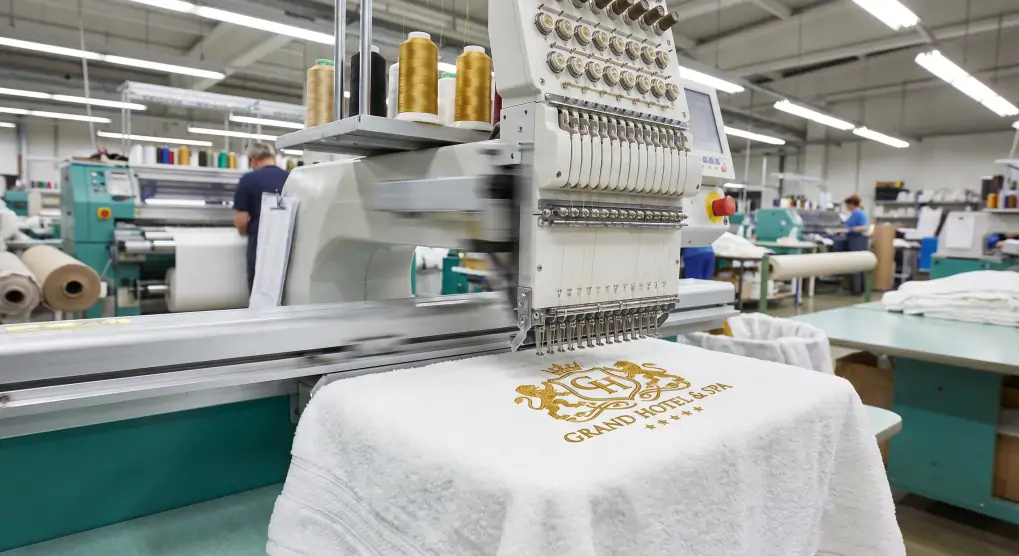
Commercial embroidery requires precise tension calibration to prevent thread breakage and Ensure consistent stitch density across the design. For logo embroidery, specify stitch count limits (typically 15,000 per design) and thread color standards using Pantone PMS codes. Our manufacturing facilities maintain embroidery machines with tension resolution to 0.1 grams.
Woven Logo Integration via Jacquard Looms
Jacquard weaving creates logos directly into towel construction, eliminating surface applications that peel or fade. This premium customization method requires minimum order quantities of 1,000 units due to loom setup complexity. Woven logos maintain appearance through unlimited wash cycles, making them ideal for high-volume hospitality operations.
Custom Labeling and Private Label Brand Integrity
Private label programs extend beyond the product to include care labels, brand tags, and packaging. Specify care instruction compliance with regional regulations (ASTM, ISO, EN standards vary by market). Our compliance team ensures labeling meets destination country requirements, preventing customs delays and market entry issues.
8. Compliance and Certification for Global Tenders
International hospitality operations require documented compliance with regional textile safety regulations. Understanding certification requirements prevents tender disqualification and ensures market access.
OEKO-TEX Standard 100 Class I Certification
This independent testing certification confirms textile products contain no harmful substances. Class I certification applies to products in close contact with skin (towels, bedding, clothing), requiring testing for 100+ harmful substances. European retailers increasingly mandate OEKO-TEX for market entry, while North American buyers recognize it as a quality indicator. Our compliance documentation page details certification protocols.
REACH Compliance for the European Market
The Registration, Evaluation, Authorization, and Restriction of Chemicals regulation governs chemical substances in textile products sold within European markets. REACH compliance requires documented testing for azo dyes, formaldehyde, and heavy metal content. Towel manufacturers must provide REACH declarations and test reports for customs clearance in EU member states.
ISO 9001:2015 Manufacturing Quality Audits
ISO 9001:2015 certification demonstrates systematic quality management throughout the manufacturing process. For large-scale hospitality procurement, audit results provide confidence in production consistency. Request audit reports from certified bodies (Bureau Veritas, SGS, TÜV) and verify certification currency before order confirmation.
Certification Checklist
Ensure your supplier provides: OEKO-TEX certificate, REACH declaration, ISO 9001 certificate, chemical safety data sheets, and test reports for each batch. Missing documentation creates supply chain risk for global operations.
9. Bulk Pricing Models and MOQ Strategies
Volume-based pricing structures reward large orders, but understanding tier thresholds helps optimize procurement budgets. Explore our wholesale pricing guide for detailed volume optimization strategies.
Tiered Pricing Based on Volume Containers
Standard tiered pricing applies discounts at 1,000, 2,500, and 5,000 unit thresholds. Typical reductions range from 8-12% at 1,000 units to 20-25% at 5,000+ units. For container-optimized orders (20-foot containers hold approximately 8,000-12,000 bath towels depending on GSM), calculate landed costs including shipping to identify true value.
Managing Lead Times for Global OEM Programs
OEM programs typically require 4-6 weeks for sample approval, 6-8 weeks for initial production, and 3-4 weeks for repeat orders. Lead time management becomes critical for multi-property deployments where staggered deliveries maintain inventory levels across locations. Our production planning team coordinates shipping schedules to meet your distribution requirements.
Raw Material Indexing and Cost Transparency
Cotton prices fluctuate based on global commodity markets. Long-term OEM contracts may specify material indexing mechanisms that adjust pricing quarterly based on established cotton price indices. For budget predictability, request fixed pricing with defined adjustment triggers rather than open-ended index provisions.
| Order Volume | Typical Discount | Lead Time | Shipping Optimization |
|---|---|---|---|
| 500-999 units | Baseline pricing | 6-8 weeks | Consolidated air freight |
| 1,000-2,499 units | 8-12% discount | 8-10 weeks | Sea freight LCL |
| 2,500-4,999 units | 15-18% discount | 10-12 weeks | Full container sea freight |
| 5,000+ units | 20-25% discount | 12-14 weeks | 20ft container optimization |
10. Industrial Laundry Compatibility Testing
Towels must survive aggressive commercial laundering while maintaining appearance and performance. Testing protocols validate product specifications under real-world conditions. Learn more about industrial laundry compatibility standards in our technical resources.
Withstanding 90-Degree Sanitization Cycles
Healthcare and food service applications require sanitization washing at 90°C (194°F). At these temperatures, standard cotton towels experience significant shrinkage and color fading unless specifically engineered for high-temperature laundering. Specify temperature-resistant construction for healthcare and foodservice applications.
Resistance to High-Alkaline Detergents
Commercial laundry detergents operate at pH 10-12 to remove body oils and organic soils. This alkalinity degrades standard cotton fibers over time, causing thinning and reduced tensile strength. Pre-treated, alkaline-resistant towels maintain integrity through 300+ high-pH wash cycles, extending service life significantly.
Tumble Dry Heat Tolerance and Pile Recovery
Industrial dryers operate at temperatures exceeding 80°C (176°F). Towel construction must withstand this heat without pile compression or fiber degradation. Pile recovery—how quickly fibers return to their original loft after compression—determines whether towels maintain their fluffy appearance through repeated drying cycles. Quality construction ensures pile recovery exceeds 95% after each dry cycle.
Request Laundry Testing Reports11. Sustainable Sourcing: BCI Cotton and Recycled Fibers
Sustainability commitments increasingly influence hospitality procurement decisions. Understanding sustainable textile options enables responsible procurement without compromising quality. Visit our sustainable manufacturing capabilities for eco-friendly options.
Integrating Better Cotton Initiative (BCI) Standards
BCI cotton is sourced through mass balance supply chains, enabling certification without requiring physical segregation through processing. BCI members commit to responsible cotton production practices including water management, soil health, and worker welfare. For corporate sustainability reporting, BCI certification provides documented evidence of responsible sourcing.
Water-Saving Bleaching Technologies
Traditional peroxide bleaching requires significant water volumes and energy for drying. Modern oxygen-based bleaching technologies reduce water consumption by 30-40% while achieving equivalent whiteness. These processes also eliminate chlorine-based compounds that create environmental discharge concerns.
The Lifecycle Analysis of Eco-Friendly Hospitality Linens
Full lifecycle analysis (LCA) evaluates environmental impact from raw material cultivation through end-of-life disposal. Cotton towels typically score well on biodegradability but poorly on water consumption. Recycled cotton blends (minimum 30% recycled content) reduce environmental impact while maintaining acceptable quality standards for mid-scale operations.
Sustainability Insight
Lifecycle analysis shows that extending towel service life from 2 years to 3 years reduces total environmental impact by 35%, even when using conventional materials. Durability specifications deliver greater environmental benefit than material substitution alone.
12. Strategic Supply Chain Optimization
Effective procurement extends beyond product specifications to encompass inventory management, logistics optimization, and quality assurance protocols. Our comprehensive supply chain management resources provide detailed guidance.
Safety Stock Management for Distribution Centers
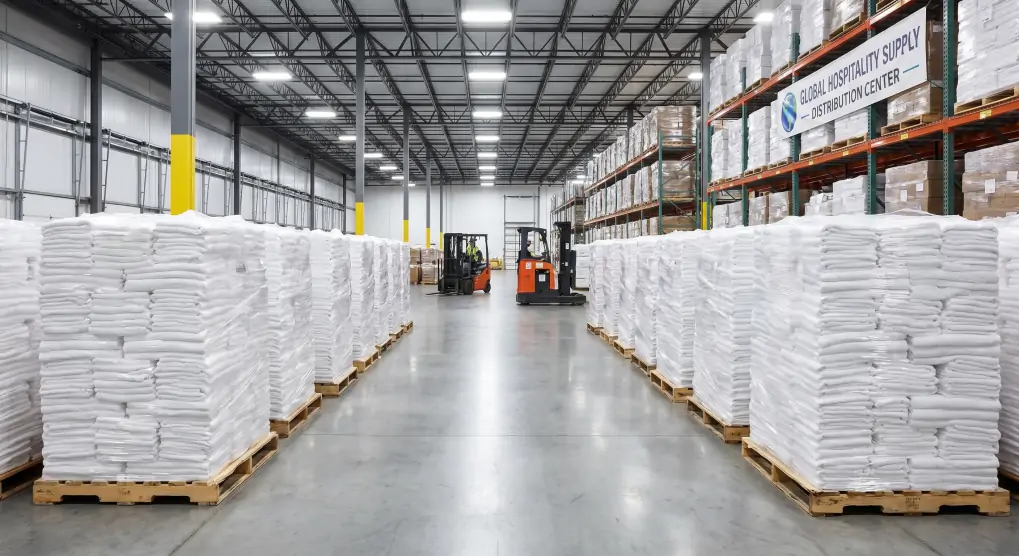
Multi-property operations require buffer inventory to prevent stockouts during demand spikes. Calculate safety stock using historical consumption data, supplier lead time variance, and desired service level (typically 95% for hospitality linens). Central distribution centers serving multiple properties can reduce total safety stock requirements by 25-40% through aggregate forecasting.
Port Logistics and Multi-Modal Sourcing
Ocean freight dominates cost-effective bulk transport, but air freight provides emergency replenishment capability. Multi-modal strategies combine container shipping for planned orders with air freight for urgent requirements. Port selection significantly impacts total landed cost—East Coast US ports offer 15-20% lower freight costs than West Coast alternatives for European and Asian origins.
Quality Control Inspections (AQL 1.5/4.0 Standards)
AQL (Acceptable Quality Level) sampling according to ISO 2859 standards provides statistical confidence in lot quality. Major defects (critical functional failures) typically use AQL 1.5, while minor defects (cosmetic issues) use AQL 4.0. For hospitality quality requirements, consider tightening these levels to AQL 1.0/2.5 for premium applications.
Frequently Asked Questions
What is the optimal MOQ for a custom-branded hotel towel OEM program?
For standard white towels with custom embroidery, the MOQ typically starts at 500 units. For bespoke woven jacquard patterns, the industrial requirement is 1,000 units due to loom setup complexities. Our OEM program details provide comprehensive MOQ guidance for each customization option.
How do you prevent the "yellowing" of white towels after repeated industrial washes?
Yellowing is often caused by residual detergent or high mineral content in water. Our towels are treated with optical brighteners that are compatible with neutral pH laundry programs, ensuring they stay "crisp white" for over 150 cycles. Request our laundry compatibility documentation for specific chemical compatibility guidance.
Can we specify different GSMs for bath towels and hand towels within the same order?
Absolutely. Most procurement strategies utilize a 600 GSM bath towel for luxury feel and a 500 GSM hand towel for faster drying and lower weight. Visit our towel specification guide for detailed GSM recommendations by application.
What certifications do your hotel towels carry for European market compliance?
Our manufacturing facilities hold OEKO-TEX Standard 100 Class I certification, REACH compliance documentation, and ISO 9001:2015 quality management certification. We provide full test reports and declarations for customs clearance in all major markets.
What is the typical lead time for bulk hotel towel orders?
Sample production requires 4-6 weeks for custom specifications. Initial bulk orders typically require 6-8 weeks for production plus shipping time. Repeat orders of established specifications can be fulfilled in 3-4 weeks. Our production planning resources detail lead time management strategies.
Conclusion: Engineering Your Hospitality Linen Program
Successful hotel towel procurement requires moving beyond price competition to embrace technical specifications that deliver operational value. Towels engineered for hospitality applications—with controlled GSM tolerance, ring-spun construction, and industrial-compatible edge reinforcement—provide consistent guest experiences while reducing long-term replacement costs.
EverBen Towels Manufacturers combines textile engineering expertise with rigorous quality protocols for global hospitality operations. Our engineering team supports procurement professionals from technical specification development through ongoing replenishment optimization.
Explore Our Topic Cluster
This article is part of our comprehensive custom towels wholesale OEM/ODM manufacturing pillar page. This pillar page serves as your complete guide to understanding our manufacturing capabilities, quality standards, compliance certifications, and B2B partnership programs.
For additional topic clusters, visit our News & Knowledge Hub for industry insights, procurement guides, and textile manufacturing expertise.
Secure Your Hospitality Supply Chain with Technical Precision
Don't let vague specifications compromise your brand standards. Our engineering team is ready to help you develop a comprehensive technical data sheet for your next bulk procurement.