Importing Towels from China to the USA: Complete Regulations & Compliance Guide (2025)
Navigating the complexities of importing towels from China can feel overwhelming for even seasoned procurement managers. The shifting landscape of tariffs, stringent U.S. Customs and Border Protection (CBP) requirements, and the critical need for quality control can create significant business risks. A single misstep in labeling, classification, or documentation can lead to costly delays, seized shipments, and damaged supplier relationships. This guide is your definitive roadmap, designed to demystify the process and empower your business to source high-quality towels from China with confidence and compliance. We will cover everything from the correct HS code for towels to calculating landed costs and ensuring your product meets all towel import regulations USA.
Overview of the U.S. Towel Import Market
Understanding the market dynamics is the first step in building a successful import strategy. The U.S. demand for towels is robust and diverse, driven by several key sectors. Simultaneously, China remains a dominant force in global textile manufacturing, offering a compelling value proposition that U.S. businesses continue to leverage.
Demand Growth in Hotels, Spas, Gyms, and Home Retail
The demand for towels is not monolithic; it's segmented across various high-growth industries.
- Hospitality Sector: Hotels, resorts, and cruise lines are among the largest consumers of towels. Guest experience is paramount, and the quality, softness, and absorbency of towels are direct reflections of a brand's standards. Chains require immense volumes for guest rooms, pools, and spas, making bulk purchasing and consistent quality essential. The post-pandemic travel boom continues to fuel this demand, with new hotel construction and renovations requiring complete linen inventories.
- Wellness and Fitness: The expanding wellness industry, including spas, gyms, and yoga studios, represents another significant market. These businesses rely on durable, highly absorbent, and often specialized towels (e.g., sweat towels, spa wraps) that can withstand frequent industrial laundering.
- Retail Market: The home goods retail sector, from big-box stores to boutique online shops, drives enormous volume. Consumers seek a wide range of products, from luxury bath towel sets to affordable multi-packs and decorative kitchen towels. Trends like organic cotton, sustainable materials (like bamboo), and unique designs create constant opportunities for new product introductions.
- Healthcare and Institutional: Hospitals, clinics, and long-term care facilities require hygienic, durable, and often standardized towels. While less focused on luxury, the demand for reliability and cost-effectiveness is high.
Why Many U.S. Buyers Choose Chinese Towel Manufacturers
Despite discussions around supply chain diversification, China's position as a manufacturing powerhouse for textiles, including towels, is built on several foundational strengths. For B2B buyers, these advantages translate into tangible competitive benefits.
Economies of Scale: China's textile industry is massive, with sprawling manufacturing hubs and vertically integrated supply chains. This scale allows for unparalleled production capacity and significant cost efficiencies, especially for large Minimum Order Quantities (MOQs).
Advanced Production Capabilities: Chinese factories have invested heavily in modern weaving, dyeing, and finishing technology. They can produce a vast array of towel types, from basic combed cotton to intricate jacquard weaves, high-GSM luxury towels, and innovative microfiber blends. This allows for extensive OEM programs and product customization.
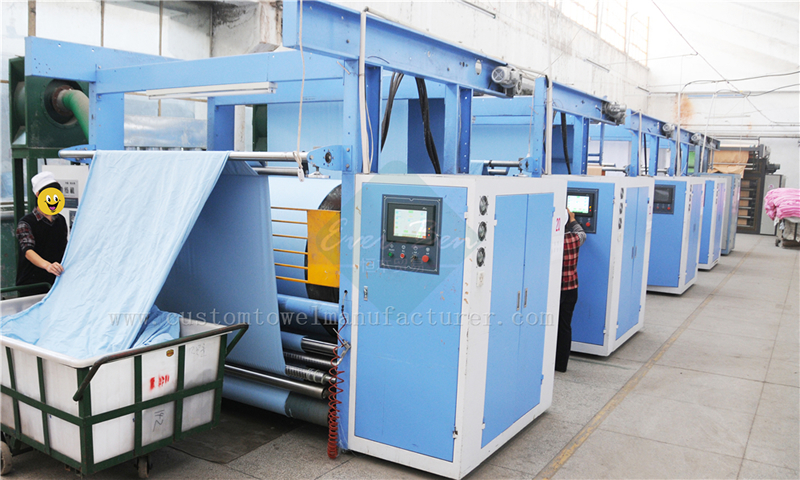
Skilled Labor and Experience: Decades of experience have cultivated a skilled workforce and a deep institutional knowledge of textile production. This expertise is crucial for managing complex orders and maintaining quality control across large production runs.
Complete Supply Chain Ecosystem: The proximity of cotton growers, yarn spinners, weavers, and dyeing facilities in key manufacturing regions reduces lead times and logistical friction within China. This integrated ecosystem is difficult to replicate elsewhere at the same scale and cost-effectiveness. Finding the best towel suppliers China B2B is often more straightforward due to platforms like Alibaba and dedicated sourcing agents.
HS Codes for Towels (Correct Classification Matters)
One of the most critical—and often overlooked—steps in the import process is correctly classifying your product using the Harmonized System (HS) code. This code determines the duty rate, admissibility, and whether other government agency requirements apply. An incorrect HS code can lead to audits, fines, and significant shipment delays. For towels, the classification primarily depends on the material composition. The relevant chapter is Chapter 63: Other made-up textile articles; sets; worn clothing and worn textile articles; rags.
HS Code for Cotton Towels
Cotton is the most common material for towels. The specific HS code falls under subheading 6302.60. * HS Code: `6302.60.00` * Description: Toilet linen and kitchen linen, of terry toweling or similar terry fabrics, of cotton. This is the go-to classification for the vast majority of bath towels, hand towels, and washcloths made from 100% cotton or a cotton-dominant blend. When filing your customs entry, you must be prepared to provide evidence of the fiber content, which is why accurate supplier information and compliant labeling are non-negotiable.
HS Code for Microfiber Towels
Microfiber towels, typically made from polyester and polyamide blends, have their own classification. They are not considered cotton terry toweling. * HS Code: `6302.93.20` * Description: Other toilet linen and kitchen linen... of man-made fibers. This code covers towels made from synthetic materials like polyester, popular for their quick-dry and high-absorbency properties often used in sports, cleaning, and travel towels. Misclassifying a microfiber towel under the cotton code is a common and costly mistake.
HS Code for Bamboo Fiber Towels
Bamboo towels present a unique classification challenge. While often marketed as a natural fiber, most "bamboo" fabric is actually a form of rayon, which is a man-made fiber created by processing bamboo pulp. * Correct HS Code: `6302.60.00` if the bamboo is blended with cotton and the cotton predominates by weight. * Correct HS Code: `6302.93.20` if it is 100% bamboo rayon or if the bamboo rayon fiber predominates by weight in a blend. The Federal Trade Commission (FTC) has strict rules on this. Unless the towels are made directly with bamboo fiber (a rare and coarse material), they must be labeled as "rayon" or "rayon made from bamboo." For customs purposes, this means they are often classified as man-made fibers, impacting the duty rate on cotton towels vs. synthetic ones. Always confirm the exact production process with your supplier.
U.S. Import Tariffs & Taxes on Towels
Calculating the total financial outlay is crucial for determining your product's market viability. The tariff on towels USA China is a multi-layered cost composed of the standard duty rate and, critically, the additional Section 301 tariffs.
Tariff Rate for Towels Imported from China
The base duty rate is determined by the HS code. As of 2024-2025, the rates for the common towel classifications are: * `6302.60.00` (Cotton Terry Towels): The standard duty rate is 9.1% *ad valorem* (based on the value of the goods). * `6302.93.20` (Man-made Fiber Towels): The standard duty rate is also calculated based on the specific type of man-made fiber, but it is typically in a similar range. These rates apply to imports from countries with Normal Trade Relations (NTR) status. However, for goods from China, this is only the beginning of the calculation.
Section 301 Tariff Impact
The most significant cost factor for importing towels from China is the additional tariff imposed under Section 301 of the Trade Act of 1974. These tariffs were implemented as part of the U.S.-China trade dispute. * Current Status: Textile products, including towels classified under HS code 6302, are subject to an additional 7.5% tariff under List 4A of the Section 301 tariffs. * Calculation: This 7.5% is calculated on the same customs value as the base duty and is *added* to the base duty. Therefore, for a shipment of cotton towels from China: Total Tariff = 9.1% (Base Duty) + 7.5% (Section 301) = 16.6% These tariffs are subject to change based on trade policy, so it is essential to consult the latest guidance from the U.S. Trade Representative (USTR) or your customs broker before finalizing an order.
How to Calculate Landed Cost (Formula)
The landed cost is the total cost of a product up to the point it arrives at your warehouse door. It is a critical metric for accurate pricing and profitability analysis.
Landed Cost = (FOB Cost) + (Shipping & Insurance) + (Customs Duty & Tariffs) + (Broker & Port Fees) + (Domestic Delivery)
Let's break it down: 1. FOB Cost: The "Free on Board" price from your supplier. This is the cost of the product plus the expense of getting it to the port of departure in China. 2. Shipping & Insurance: The cost of ocean or air freight from China to the U.S. port, plus insurance to cover potential loss or damage. 3. Customs Duty & Tariffs: Calculated as a percentage of the commercial invoice value (e.g., 16.6% for cotton towels from China). 4. Broker & Port Fees: This includes the customs broker's fee for handling the entry, Merchandise Processing Fee (MPF), and Harbor Maintenance Fee (HMF). * MPF: 0.3464% of the shipment value (min $29.66, max $575.35 in 2024). * HMF: 0.125% of the shipment value (for ocean freight only). 5. Domestic Delivery: The cost of trucking the container from the U.S. port to your final destination (warehouse or distribution center). Understanding this formula is the key to avoiding surprises and ensuring your import program is profitable.
U.S. Regulations for Importing Towels
Compliance with U.S. regulations is not optional. CBP, along with the FTC, enforces a strict set of rules for textiles. Non-compliance results in refused entry, penalties, and potential product seizure.
CBP Textile Import Compliance Rules
CBP is the frontline agency for enforcing all import laws. For textiles, their primary concerns are: * Proper Classification: Using the correct HS code. * Accurate Valuation: Ensuring the commercial invoice reflects the true transaction value to prevent duty evasion. * Country of Origin: Verifying that the product is correctly marked with its country of origin. * Intellectual Property Rights: Screening for counterfeit goods or trademark infringements. CBP textile compliance is data-driven. They may request detailed documentation or conduct physical inspections (intensive exams) to verify the information on your customs entry.
Country of Origin Marking Requirements
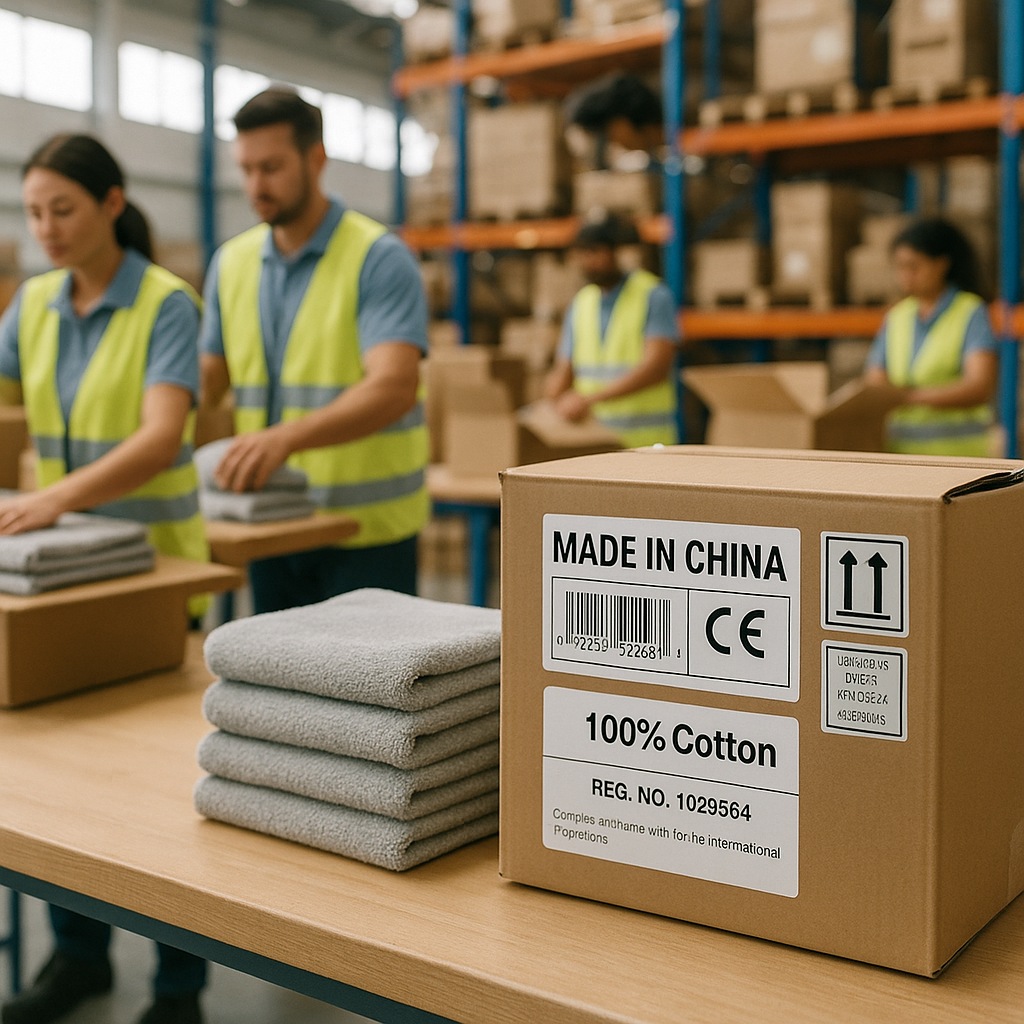
All towels imported into the USA must be permanently and conspicuously marked with their country of origin. For textiles, this is a particularly strict requirement. * Marking: The words "Made in China" must be on a label sewn into the towel. A disposable sticker or hang-tag is insufficient. * Legibility and Permanence: The label must be able to withstand handling and remain legible until it reaches the ultimate consumer. It should be stitched securely into a seam. * Location: The label should be easy to find. Common practice is to sew it into one of the side seams. Failure to comply with Made in China towel labeling rules is a frequent reason for CBP detentions. The importer is then responsible for the cost of bringing the goods into compliance (e.g., shipping them to a bonded warehouse to have labels sewn on) before they can be released.
Fiber Content Labeling (16 CFR Part 303)
The Textile Fiber Products Identification Act, enforced by the FTC, mandates that textile products be labeled with their fiber content. * Requirement: The label must state the generic names of the fibers present in order of predominance by weight, along with their percentages. For example: "80% Cotton, 20% Polyester". * Accuracy: The percentages must be accurate within a small tolerance. * Bamboo Rule: As mentioned earlier, "bamboo" must be listed as "rayon" unless it is true mechanical bamboo fiber. * Combined Label: This information can be on the same label as the country of origin. A compliant label might read: > Made in China > 100% Cotton
Care Labeling Rules (16 CFR Part 423)
The FTC's Care Labeling Rule requires manufacturers and importers to attach care labels to garments and certain piece goods. Towels are included. * Requirement: The label must provide complete instructions for at least one safe cleaning method (e.g., washing, drying, ironing, bleaching). Using standardized ASTM symbols is a common and effective practice. * Basis: You must have a "reasonable basis" for the care instructions you provide, meaning you should have evidence (like testing results) that the instructions will not damage the product. * Example Instructions: "Machine wash warm, gentle cycle. Tumble dry low. Do not bleach." All three labeling requirements—Country of Origin, Fiber Content, and Care Instructions—can often be combined onto a single, durable, sewn-in label to ensure full compliance.
Certification & Testing Requirements
Beyond mandatory regulations, certain certifications and tests are crucial for market access, risk management, and brand reputation. They signal to B2B customers and end-consumers that your product is high-quality and safe.
OEKO-TEX Standard Certification
**OEKO-TEX Standard 100** is a globally recognized, independent testing and certification system for raw, semi-finished, and finished textile products. * What it Certifies: It tests for a wide range of harmful substances, from regulated chemicals like specific azo dyes to those that are not yet legally regulated but are known to be harmful to health. * Why it Matters: Many U.S. retailers and hotel chains now require OEKO-TEX certification for towels as part of their procurement standards. It serves as a powerful marketing tool, assuring customers that the towel is safe for their skin. * Process: Your Chinese supplier must have their products and production processes certified by an OEKO-TEX institute. You should request a copy of their valid certificate and verify its authenticity on the OEKO-TEX website. This is a factory-level certification, not something an importer can obtain on their own.
AZO Dyes and Formaldehyde Restrictions
While OEKO-TEX covers these, it's important to understand the specific risks they pose. * Azo Dyes: Certain azo dyes can release carcinogenic aromatic amines. They are heavily restricted in the EU and are a major concern for U.S. regulators and consumers. While the U.S. does not have an overarching federal ban like the EU's REACH regulation, state regulations (like California's Proposition 65) and general product safety rules effectively require importers to ensure their textiles are free from these harmful dyes. * Formaldehyde: This is often used as a finishing agent to prevent wrinkling. However, high levels of residual formaldehyde can cause skin irritation and allergic reactions. Testing for formaldehyde content is a standard part of due diligence, especially for products that come in direct contact with skin.
CPSIA Requirements for Baby Towels
If you are importing towels specifically designed for children 12 years of age or younger (e.g., hooded baby towels), the Consumer Product Safety Improvement Act (CPSIA) applies. * Key Requirements: 1. Third-Party Testing: The products must be tested by a CPSC-accepted laboratory for compliance with all applicable children's product safety rules (e.g., lead in surface coatings, phthalates). 2. Children's Product Certificate (CPC): You, the importer, must issue a CPC that certifies the product complies with all applicable safety rules based on the passing test reports. 3. Tracking Labels: The product must have a permanent tracking label with information that allows you to trace the manufacturing location, date, and batch number. FDA requirements for textiles are generally not applicable unless the towel is marketed as a medical device (e.g., having antimicrobial properties that claim to treat a disease). For standard towels, the FTC and CPSC are the primary regulatory bodies.
Documentation Checklist for Customs Clearance
Organized and accurate paperwork is the key to a smooth customs clearance process. Your freight forwarder or customs broker will guide you, but as the Importer of Record, you are ultimately responsible for its accuracy.
Commercial Invoice
This is the most important document. It is the primary bill of sale and is used by CBP to determine the customs value and classify the goods. It must include: * Importer and Seller details. * A detailed description of the goods (e.g., "100% Cotton Terry Bath Towels"). * Quantity, unit price, and total value. * Country of Origin. * HS Code. * Incoterms (e.g., FOB Shanghai).
Packing List
A detailed inventory of the shipment. It should specify the contents of each carton, including quantities, dimensions, and net/gross weight. This is used by CBP to physically verify the shipment if an inspection is ordered.
Bill of Lading (B/L) / Air Waybill (AWB)
This is the contract between you and the carrier (shipping line or airline). It serves as a receipt for the goods and a document of title. * Ocean Freight: A Bill of Lading is issued. An "Express Release" or "Telex Release" is common, allowing you to claim the cargo without needing the original paper B/L. * Air Freight: An Air Waybill is issued. It is non-negotiable.
Certificate of Origin (CO)
While the country of origin is stated on the commercial invoice and marked on the product, a separate Certificate of Origin issued by a chamber of commerce in China can sometimes be requested by CBP to further substantiate the origin claim, especially for goods subject to trade remedies like Section 301 tariffs.
Testing Reports (Optional but Recommended)
While not always required for customs clearance itself, having these on hand is crucial. If CBP questions your fiber content claims or has safety concerns, providing test reports for fiber analysis, OEKO-TEX certification, or CPSIA compliance can expedite resolution and demonstrate due diligence.
Choosing a Reliable Towel Supplier in China (B2B Focus)
Your supplier is your most important partner. A great supplier ensures quality, compliance, and reliability. A poor one can jeopardize your entire business.
Key Cotton Manufacturing Regions in China
Knowing where to look is half the battle. Towel manufacturing is concentrated in specific provinces known for their textile expertise: * Shandong Province: A major hub for cotton production and textiles. Cities like Gaomi and Zibo are famous for their towel factories. * Hebei Province: Particularly the city of Baoding, is another massive cluster of towel manufacturers, known for competitive pricing and large-scale production. * Jiangsu Province: Known for slightly higher-end textiles and a strong focus on quality control.
Factory Audit Checklist for Towels
Before placing a large order, a factory audit (either in-person or via a third-party service) is essential. * Business License & Certifications: Verify their legal status and certifications (like ISO 9001, BSCI, OEKO-TEX). * Production Capacity: Do they have the equipment and staff to handle your MOQ and future growth? * Quality Management System (QMS): How do they check for defects? Do they have incoming material inspection, in-process checks, and final product inspection? * Social Compliance: Check for adherence to labor laws to avoid ethical sourcing risks. * R&D and Customization: Assess their ability to develop new products or customize towels to your specifications (OEM programs).
How to Verify GSM, Absorbency, Yarn Count, and Stitch Quality
These are the key technical specifications for a quality towel.
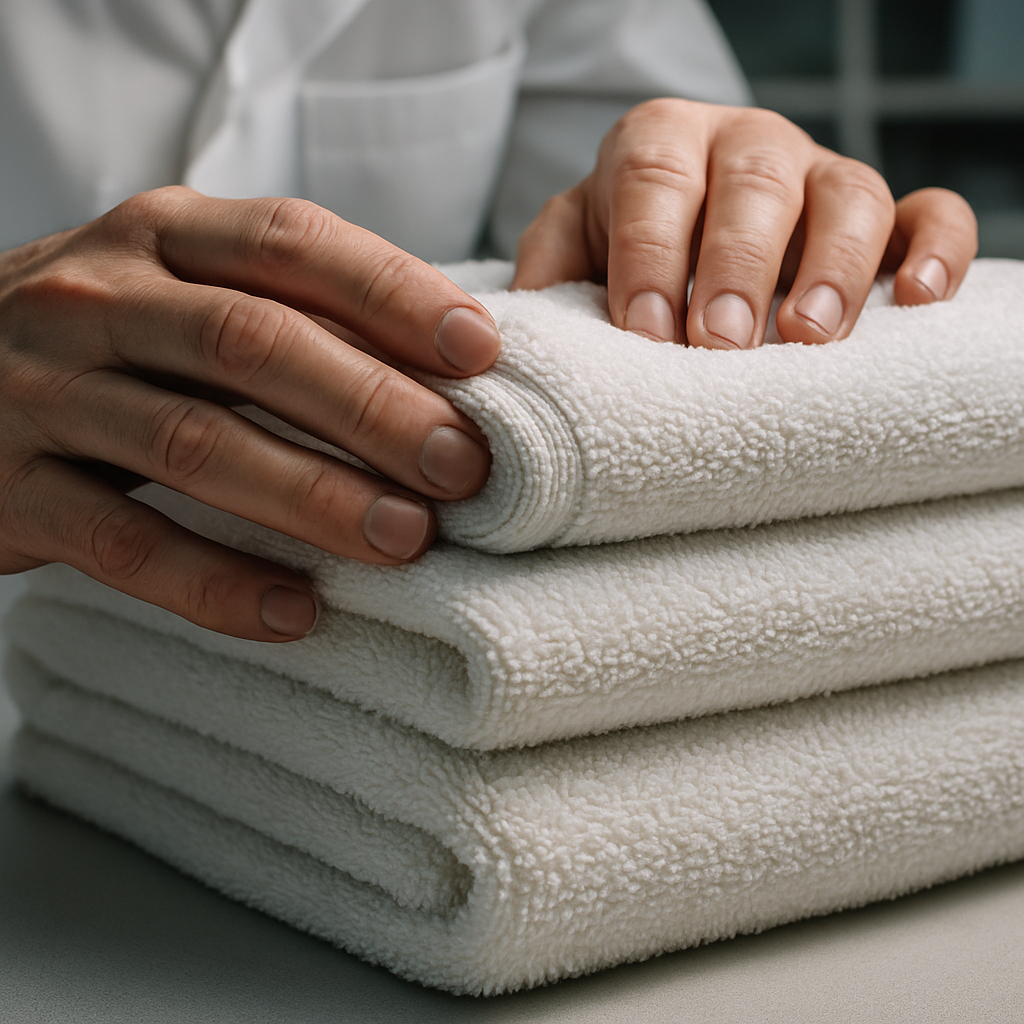
GSM (Grams per Square Meter): This measures the towel's density and weight, a primary indicator of quality and absorbency. A luxury bath towel is typically 600-900 GSM, while a standard hotel towel is 400-600 GSM. You can verify this by weighing a sample of a known size.
Absorbency: A simple water test can give a good indication. A more formal test measures the time it takes to absorb a drop of water.
Yarn Count: Higher-quality towels use combed, ring-spun, or zero-twist cotton yarns, which are softer and more durable than standard carded open-end yarns. Ask the supplier for yarn specifications.
Stitch Quality: Inspect the hems. They should be double-stitched with a high stitch density to prevent fraying after multiple washes.
Red Flags to Watch Out For
* Unusually low prices (often indicates poor materials or cut corners). * Inability or unwillingness to provide samples. * No verifiable certifications or a refusal to allow a factory audit. * Poor communication or vague answers to technical questions. * Requesting 100% payment upfront (standard terms are typically 30%-50% deposit, balance upon completion/shipment).
Shipping Towel Orders from China to the USA
Logistics can make or break your timeline and budget. The main choice is between sea and air freight.
FCL vs LCL for Towels
For sea freight, you will ship via FCL or LCL. * FCL (Full Container Load): You book an entire 20ft or 40ft container. This is the most cost-effective method for larger orders. A 40ft container can hold thousands of towels. The container is sealed at your supplier's factory and opened at your warehouse, reducing handling and risk of damage. * LCL (Less than Container Load): Your goods share container space with other importers' cargo. This is suitable for smaller orders that don't fill a full container. However, the per-unit cost is higher than FCL, and there is a greater risk of damage or loss due to increased handling at consolidation warehouses. This choice directly relates to your LCL vs FCL towel shipping strategy.
Sea Freight vs. Air Freight
* Sea Freight: The default choice for towels. It is significantly cheaper but slower. Transit time from a major Chinese port (like Tianjini, Shanghai or Ningbo) to a U.S. West Coast port (like Long Beach) is about 15-25 days, plus time for customs clearance and ground transport. To the East Coast, it's 30-40 days. * Air Freight: Extremely expensive for a bulky product like towels. It should only be used for urgent sample shipments or very small, high-value orders. Transit time is just a few days, but the cost can be 5-10 times that of sea freight.
Freight Forwarder Role
A freight forwarder is an essential partner. They do not own the ships or planes but act as your logistics agent. Their role includes: * Booking space on the vessel/aircraft. * Managing inland transportation in China and the U.S. * Preparing shipping documentation. * Often providing or partnering with a customs broker to handle customs clearance. Choosing a reputable forwarder with experience in China-U.S. trade is critical.
Cost Breakdown Example (Realistic)
Let's illustrate the landed cost for a hypothetical order of 5,000 cotton bath towels.
| Cost Component | Description | Example Cost (USD) |
|---|---|---|
| FOB Cost | 5,000 towels @ $4.00/towel (FOB Shanghai) | $20,000.00 |
| Ocean Freight | 1 x 20ft container, Shanghai to Long Beach | $2,500.00 |
| Insurance | 0.5% of (FOB + Freight) | $112.50 |
| Customs Value | FOB Cost | $20,000.00 |
| Customs Duty | 9.1% of Customs Value | $1,820.00 |
| Section 301 Tariff | 7.5% of Customs Value | $1,500.00 |
| MPF & HMF | (0.3464% + 0.125%) of Customs Value | $94.28 |
| Broker & Port Fees | Customs clearance, terminal handling, etc. | $650.00 |
| Domestic Delivery | Trucking from Long Beach to a local warehouse | $800.00 |
| Total Landed Cost | Sum of all costs | $27,476.78 |
| Landed Cost Per Towel | Total Landed Cost / 5,000 | $5.50 |
This example clearly shows how the initial $4.00 FOB price becomes a $5.50 landed cost, an increase of nearly 38%. Factoring this in from the start is essential for proper budgeting and pricing. Pls note: the Tariff and duty are change according USA trade polices.
Case Study: A U.S. Hotel Chain Importing Towels from China
Company: "Coastal Comfort Hotels," a mid-size U.S. hotel chain with 25 properties. Goal: Procure 30,000 high-quality, durable bath towels for a chain-wide refresh, optimizing cost without sacrificing guest experience.

Requirements
* Product: 550 GSM, 100% ring-spun cotton bath towels. * Specifications: Custom logo woven into the towel (jacquard), double-stitched hems for durability. * Compliance: Must be OEKO-TEX Standard 100 certified. All U.S. labeling laws must be met. * Budget: Target landed cost under $6.00 per towel.
Quality Control Process
1. Supplier Vetting: The procurement team identified three potential suppliers in Shandong and Hebei. They conducted remote video audits and hired a third-party service for on-site inspections. They chose a supplier with existing OEKO-TEX and BSCI certifications. 2. Sample Approval: Pre-production samples were requested to verify GSM, feel, logo accuracy, and shrinkage after washing. 3. In-Process Inspection: An inspector was sent to the factory mid-production to check for consistency and identify any early-stage defects. 4. Final Inspection: Before the 70% balance payment was made, a final random inspection was conducted, checking for defects, verifying packaging, and ensuring all labeling was 100% compliant.
Cost Optimization
* Bulk Order: By consolidating the entire chain's needs into one large order, they achieved a lower FOB price. * Sea Freight (FCL): The order filled multiple 40ft containers, making FCL shipping the most economical choice. * Tariff Engineering (Considered but Rejected): They explored blending cotton with a small amount of polyester to potentially change the HS code but decided against it to maintain their "100% Cotton" luxury promise. * Negotiation: They negotiated FOB terms and leveraged the large order volume to secure a favorable price. The project was a success. The hotel chain achieved a final landed cost of $5.85 per towel, meeting their budget and quality standards. The stringent QC process prevented any compliance or quality issues upon arrival.
Final Recommendations for First-Time Importers
If you are new to importing towels from China, the process can be mastered by following a disciplined approach.
Start with Samples
Never commit to a bulk order without first obtaining and thoroughly testing pre-production samples. Wash them, use them, and compare them against your quality benchmarks. This small initial investment can save you from a disastrously large bad investment later.
Use Third-Party QC
Do not rely solely on your factory's internal quality control. Hire an independent inspection company in China to conduct a pre-shipment inspection. This provides an unbiased report on quality and compliance before you release the final payment and the goods leave the port.
Keep Labeling 100% Compliant
Labeling mistakes are one of the most common and easily avoidable reasons for customs delays. Create a clear labeling guide for your supplier that specifies the exact wording for the country of origin, fiber content, and care instructions, as well as the label's material and placement. Double-check this during your final inspection. A small error here can have huge financial consequences. By following the comprehensive guidelines in this document, you can effectively manage the risks and unlock the significant benefits of sourcing towels from China, ensuring your business receives high-quality, compliant products at a competitive price point.
Frequently Asked Questions (FAQ)
1. What is the average duty rate on towels from China? For cotton terry towels (HS code 6302.60.00), the total tariff is approximately 16.6%. This is a combination of the standard 9.1% duty rate plus the 7.5% Section 301 additional tariff on Chinese goods.
2. Do I need a license to import towels into the USA? No, you do not need a specific license to import towels. However, you will need to act as the Importer of Record, which may require you to obtain a customs bond. Your customs broker can facilitate this process.
3. How can I find reliable towel suppliers in China? Suggest you use google search, AI search, or from facebook, linkedin, youtube, attend trade shows like the Canton Fair, or hire a reputable sourcing agent based in China who can vet factories on your behalf.
4. What is GSM and why is it important for towels? GSM stands for Grams per Square Meter. It measures the density and weight of the towel's fabric. A higher GSM (e.g., 600-900) indicates a thicker, more absorbent, and more luxurious towel, while a lower GSM (300-400) is typical for lightweight or economy towels.
5. Can I get my towels shipped by air freight? You can, but it is generally not recommended for bulk orders due to the high cost. Towels are relatively bulky and light, making air freight prohibitively expensive compared to sea freight. Air freight is best reserved for small, urgent sample shipments.